
I
Discovery
Identification sample analysis
Import a sample file (JSON, CSV, etc.) so PrettyWhale.ai can automatically analyze its structure, detect fields, and understand how your data is organized. No manual setup required.
Generate your data ingestion pipelines effortlessly.
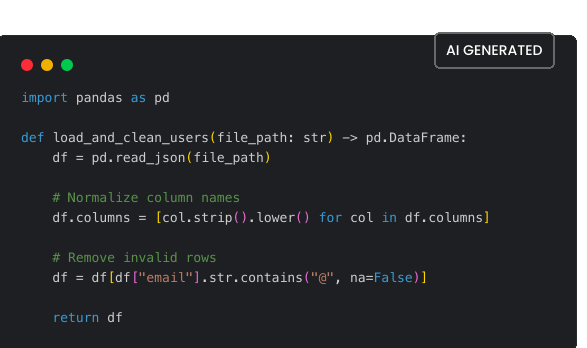
PrettyWhale.ai is an Engineering AI built on a specialized small language model (SLM) trained for one job:
generate ingestion and integration code.
From a sample of data to a complete pipeline, effortlessly.
Identification sample analysis
Import a sample file (JSON, CSV, etc.) so PrettyWhale.ai can automatically analyze its structure, detect fields, and understand how your data is organized. No manual setup required.
Scope of data
PrettyWhale.ai generates a detailed analysis of your data, highlighting each field with examples and insights. You can then select only the fields you want to keep, giving you full control over your dataset.
Transform suggestion
Based on the analysis, PrettyWhale.ai suggests relevant transformations such as normalization, formatting, and data cleaning. You can easily review, adjust, remove, or add your own transformations to match your exact requirements.
Suggestion and selection
Enhance your dataset by connecting to external data sources. PrettyWhale.ai helps you enrich your data with additional context, making it more complete and valuable for downstream use.
Code and deliverables
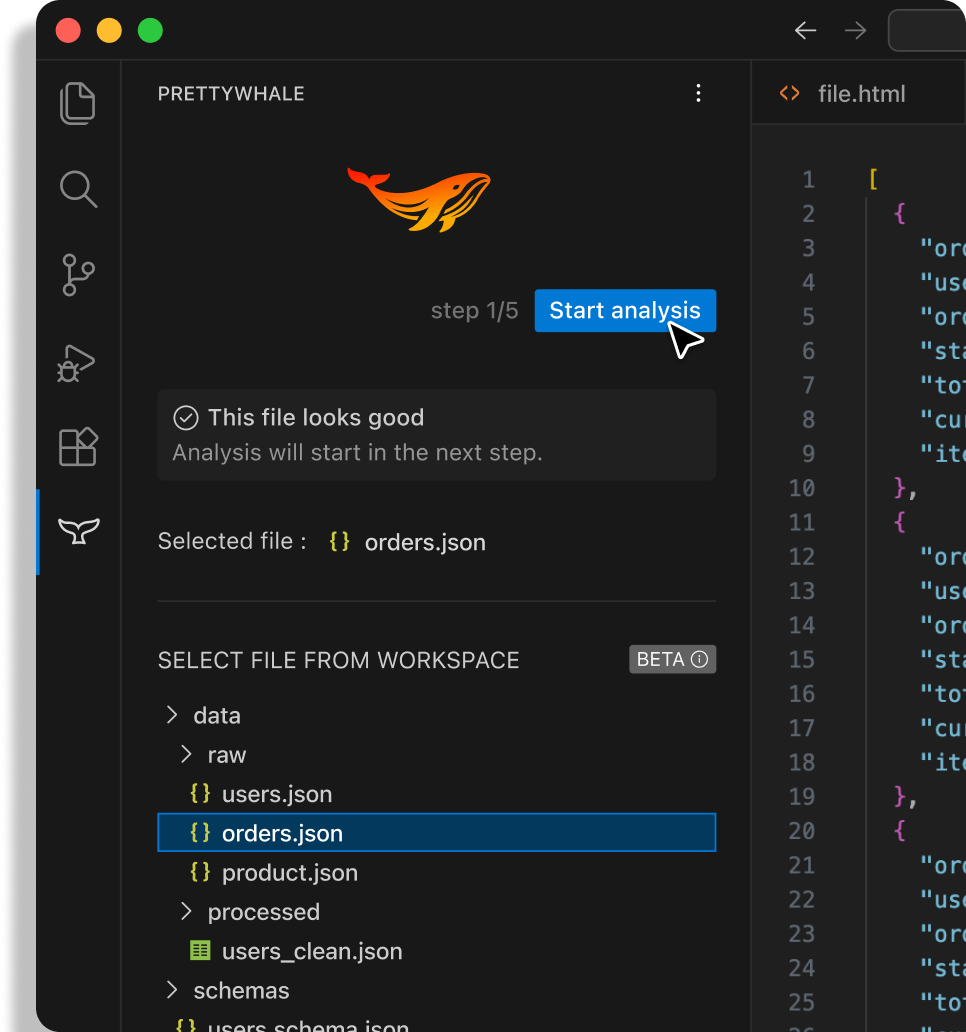
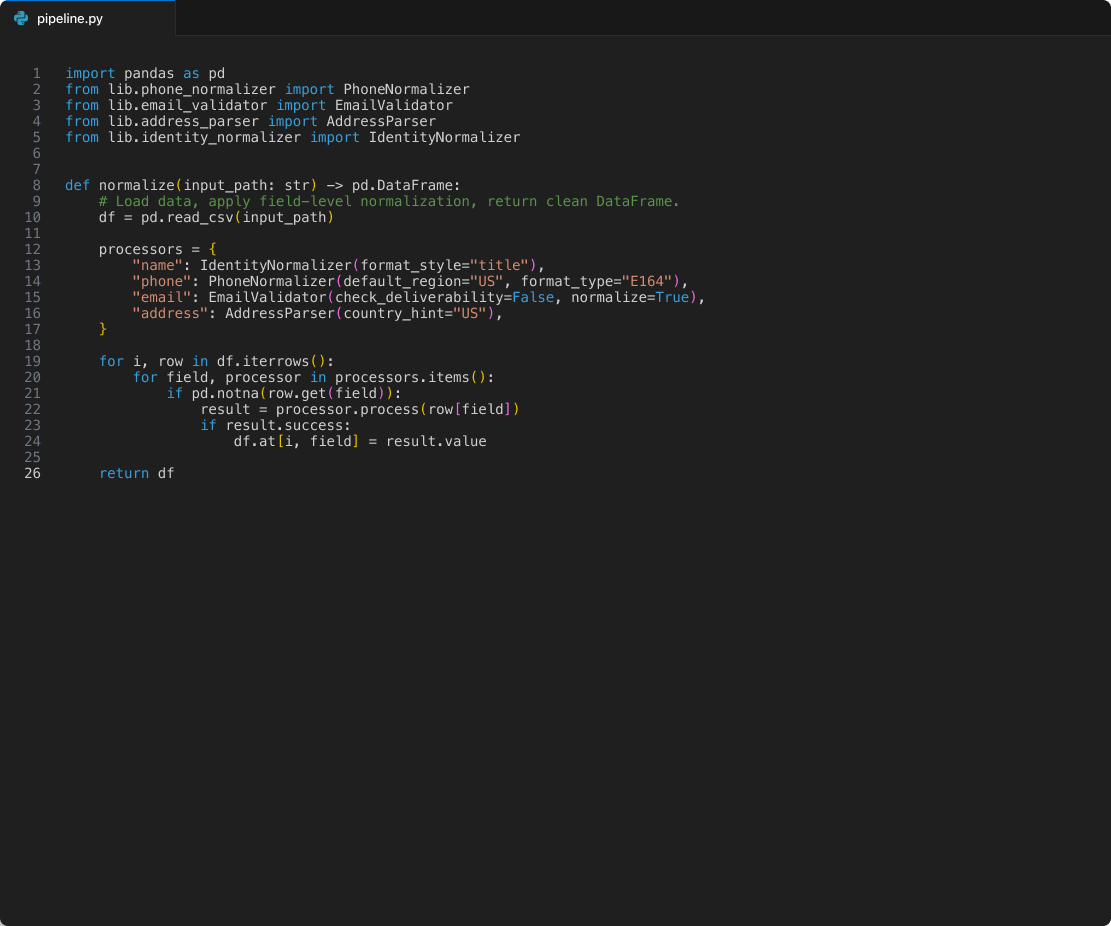
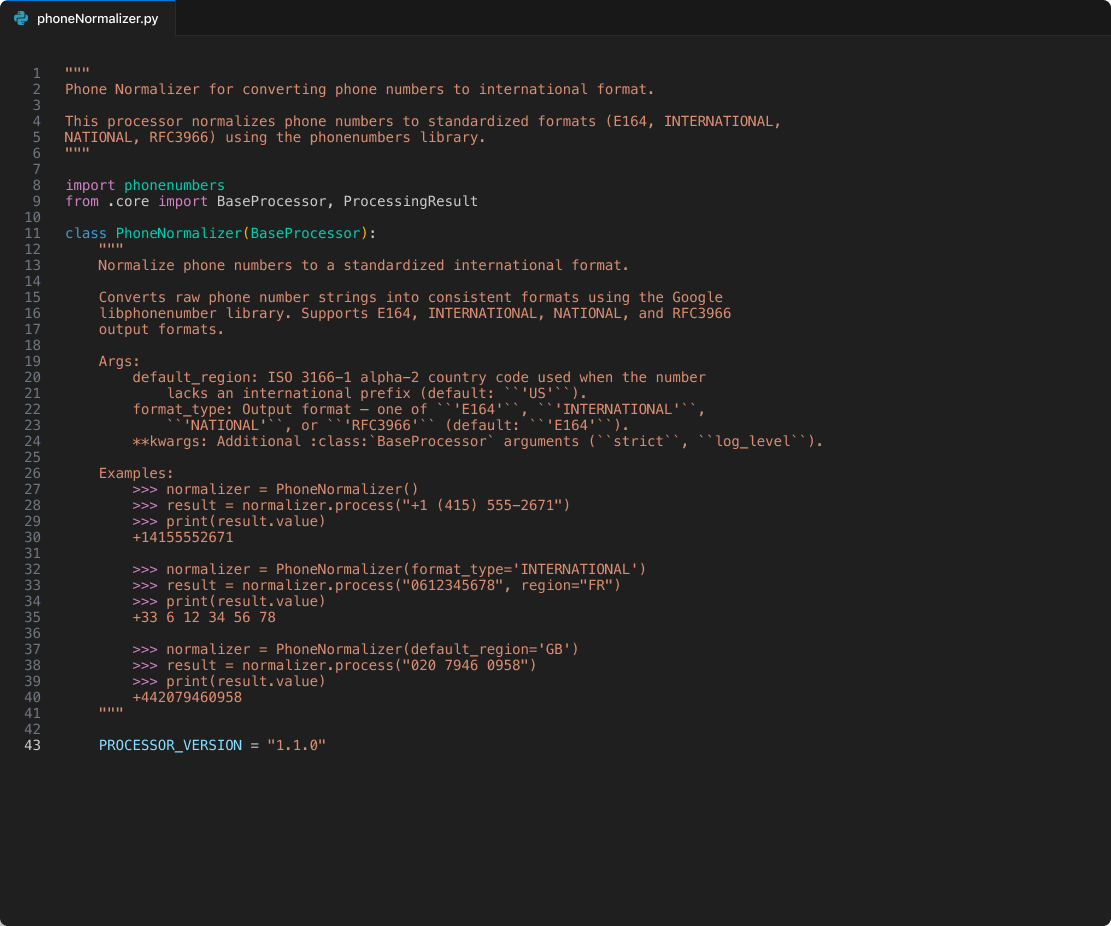
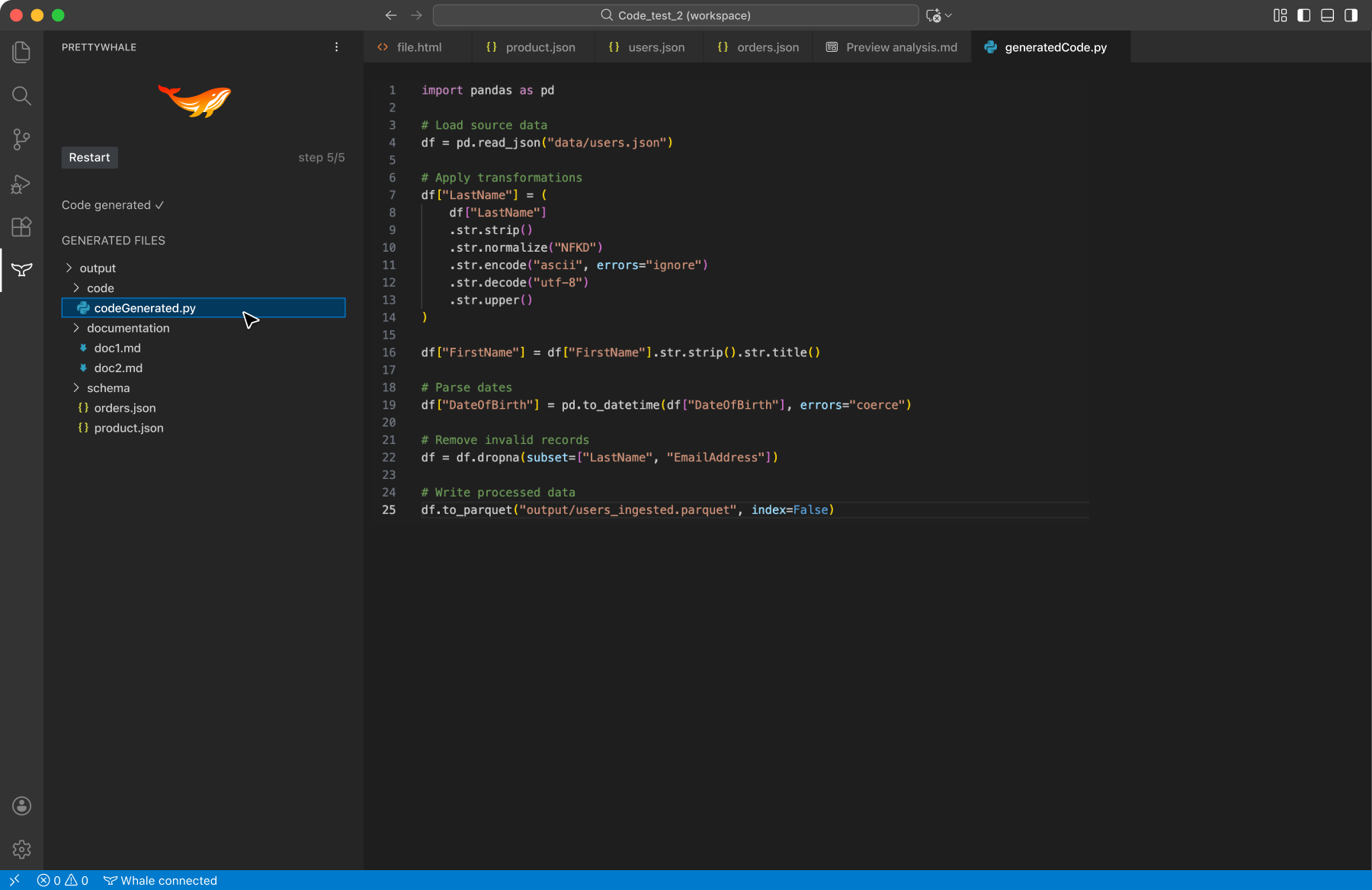
PrettyWhale.ai generates everything you need: ingestion code, documentation, schemas, and unit tests. The code is validated and ready to be deployed in production, saving hours of manual work.




he 5 data engineering trends that will shape 2027, from pipeline agents to the EU Data Act, built on what shipped this year and what comes next.
Discover why naive LLM self-debugging breaks unit tests in automated code generation and how contract-driven agentic architectures fix it.
Discover how AI is dismantling the billable hour in IT services. Explore how the shift toward outcome-guaranteed contracts and asset-based consulting is redefining professional services.
Code generation became a commodity. What did not is the engineering frame around the model. Why the next wave is specialized harnesses, and what one contains for data.
Every correction you type into a copilot is a requirement you already knew. Driving one means re-expressing your standards forever, one prompt at a time.
Lock-in is not a contract term, it is a rewrite estimate. Why the ingestion layer accumulates it faster than anything else, and how to measure yours today.
Small language models can match large ones on a bounded job like code generation, at 10 to 30 times lower serving cost. Here is when that trade holds.
Code review assumes an author who can answer for the code. Generated code breaks that assumption. What changes in the pull request, and after an incident.
Ask two engineers when an ingestion pipeline is finished and you get two answers. Here is how to write the bar down on one page and enforce it in review.
Stop estimating ingestion tasks one by one. Estimate units of work, build a tier grid from your own delivery history, and recalibrate it after every project.
Moove-SI, an integrator specialising in Microsoft solutions, is adding PrettyWhale.ai to its Data & AI offer to speed up the costliest part of data projects.
"AI writes code now" covers four product families with four failure modes. The criterion that separates them, and four questions to pick the right one.
For thirty years IT services firms sold human time by the day. Clients now ask what you save them, not how many consultants you can put on the project.
Ingestion and integration code get used as synonyms. They solve different problems, and the teams that optimise the wrong one pay for it in production.