
The Age of Generic Copilots Is Over. Enter Specialized Harnesses.
For the past three years, the software industry has been obsessed with a single interface: the chat box. We were told that a large enough model, paired with a generic autocomplete plugin, would transform software engineering forever.
It worked-up to a point: generating syntax, scaffolding boilerplates, or writing basic utility functions became trivial. But as the hype settles, engineering teams are facing a harsh reality: code generation is a solved problem; code verification and maintainability are the new issues.
In specialized domains like Data Engineering, generic LLM copilots have hit a hard ceiling. The issue isn't the size of the context window or the reasoning capabilities of the underlying model. The issue is that generic tools lack an engineering frame.
It is time to move past generic AI assistants. The next phase of engineering software belongs to specialized execution harnesses.
From Models to Frameworks: An Industry Pattern
To understand where AI-assisted engineering is going, we only need to look at the history of software development.
In the early days of web development, engineers wrote raw scripts directly against web servers. It was flexible, fast to deploy, and completely unmanageable at scale. Security vulnerabilities were rampant, folder structures were arbitrary, and maintaining someone else’s code was a nightmare.
The industry didn't solve this by telling developers to "think harder" or write better comments. It solved it through frameworks. These systems didn't take away the developer's agency; they imposed strict conventions, automated testing setups, defined migration pathways, and standardized execution environments.
Generative AI is undergoing the exact same transition. Prompting a raw LLM through a chat sidebar is the modern equivalent of writing unconstrained web scripts in 2002. It gives you instant code, but leaves you with all the architectural debt.
Data Engineering doesn't just need a model that knows better Python syntax. It needs an execution framework that understands the physics of data.
Why Generic Copilots Fail at Data Integration
Web interfaces fail noisily with a broken component or a 500 status code. Data pipelines fail quietly.
When an ingestion pipeline breaks due to a hidden API payload change, a missing null check, or an implicit type conversion, the pipeline rarely crashes immediately. Instead, it pollutes downstream data warehouses, corrupts analytical dashboards, and quietly wrecks machine learning models. You only discover the issue weeks later when financial reports don't reconcile.
A generic AI copilot cannot prevent this because it operates without operational context:
- It guesses instead of profiling: A copilot looks at a small snippet of JSON and assumes the schema. It doesn't analyze 100,000 rows to detect edge-case nullability, varying array lengths, or timestamp variations.
- It lacks deterministic guardrails: Prompting an LLM to "handle all errors and follow best practices" is a suggestion, not a guarantee. The model will still omit retry logic or drop malformed records when context limits pressure it.
- It shifts the burden of proof: When a copilot generates 200 lines of complex extraction code, the data engineer must manually audit every single line. The time saved writing code is lost reviewing hallucinated logic.
Asking a generic LLM to write data pipelines without strict environmental constraints is simply asking for technical debt.
What Is a Specialized Execution Harness?
A Specialized Execution Harness is not a wrapper around an API, nor is it a complex system prompt. It is a deterministic execution environment built around a domain-specific model. It controls, constrains, validates, and tests every output produced by the AI before a human ever sees it.
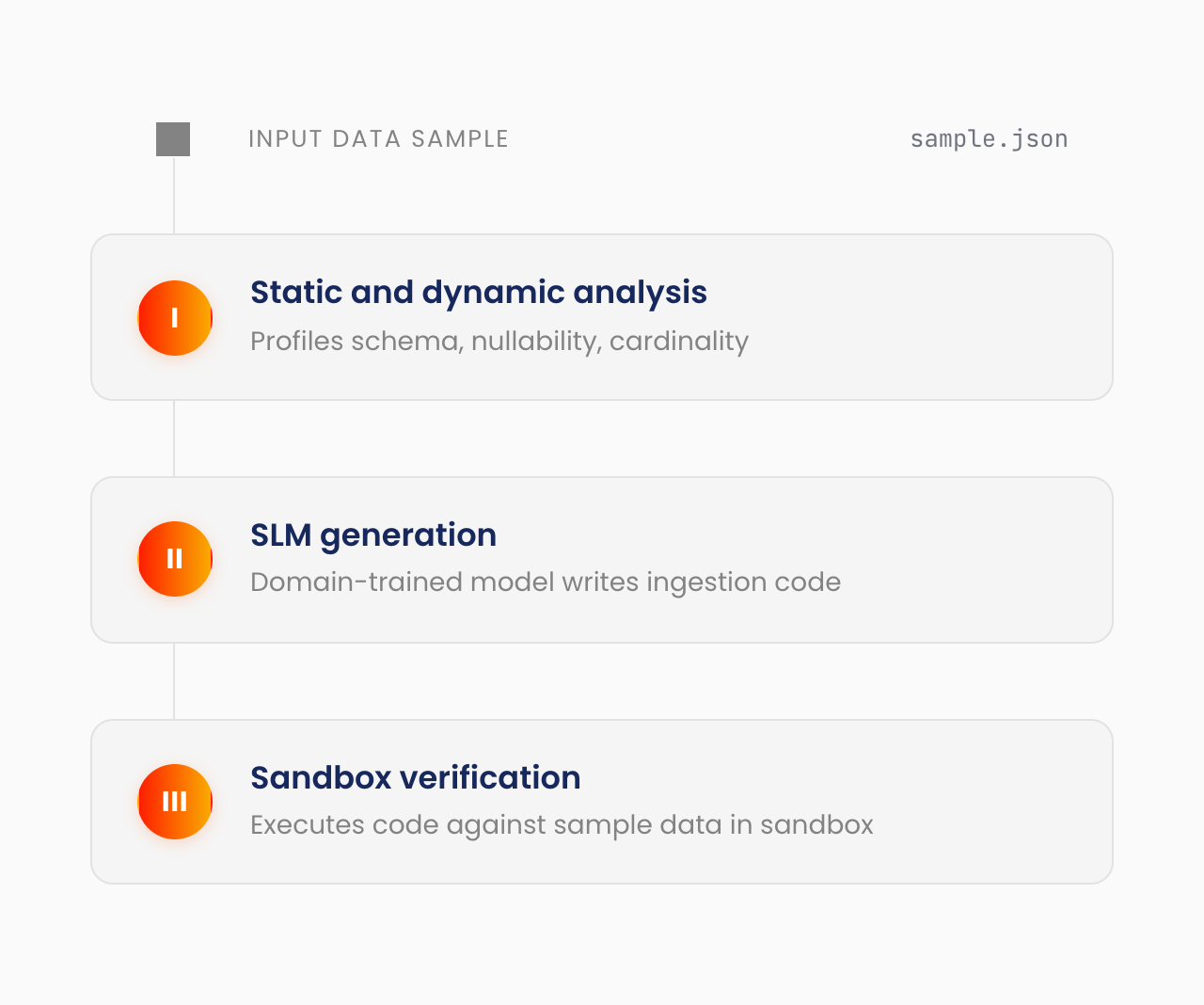
At PrettyWhale.ai, we designed our harness around the specific constraints of data ingestion and integration. Instead of relying on a multi-purpose LLM, the architecture couples a Small Language Model (SLM), trained explicitly on data engineering patterns, with a multi-stage validation engine.
The 4 Pillars of a Data Engineering Harness
- Deterministic Analysis First: Before any code is generated, the harness runs static and dynamic analysis on raw source payloads (JSON, CSV, Parquet, or API endpoints). It calculates schema shapes, field cardinality, and boundary conditions programmatically.
- Context Enforcement: The harness forces the generation process to adhere strictly to target destination specifications, corporate retry policies, logging standards, and schema validation rules.
- Automated Sandbox Execution: The harness does not present raw code to the engineer. It spins up an isolated sandbox, executes the generated pipeline against real data samples, and verifies that data lands correctly without silent loss.
- Self-Correction Loop: If the sandbox execution fails or detects a schema mismatch, the execution trace is fed directly back to the model. The system fixes its own code inside the harness before delivering the final result.
From "Code Generation" to "Software Engineering AI"
The fundamental shift happening right now is from unassisted code generation to verified software assets.
| Generic Copilot Approach | Specialized Harness Approach |
|---|---|
| Input: Natural language prompt ("Write a connector for X"). | Input: Actual data source sample and schema constraints. |
| Process: Probabilistic completion based on web training data. | Process: Profiling \rightarrow Specialized Generation \rightarrow Sandbox Execution. |
| Output: Raw text file containing code. | Output: Verified package (Code, passing tests, schema, docs). |
| Review Method: Manual line-by-line code audit by an engineer. | Review Method: Verification of execution proofs and test results. |
| Failure Mode: Silent runtime failures in production. | Failure Mode: Sandbox flags errors before deployment. |
When an AI system delivers code alongside its own execution proof, the developer's role evolves. You no longer spend 45 minutes line-debugging synthetic code. You spend two minutes reviewing verified test runs and architectural alignment.
This is what turning AI into an engineering tool actually looks like.
The Future Belongs to Domain Specificity
The era of expecting a single chat model to design user interfaces, optimize SQL queries, configure Kubernetes clusters, and write data ingestion pipelines with equal reliability is over.
Just as general-purpose CPUs gave rise to specialized GPUs for graphics and AI workloads, general-purpose LLMs are giving way to specialized harnesses for domain-critical engineering tasks.
At PrettyWhale.ai, we built our execution harness because we believe data engineers shouldn't spend their lives writing or debugging fragile boilerplate ingestion scripts. By wrapping domain-trained models in a deterministic, self-verifying harness, we can finally give data teams what they actually need: pipelines that work, backed by proof, every single time.
PrettyWhale.ai is an Engineering AI for ingestion and integration code: a specialised harness around a small model trained on that code alone. It works from a real sample of the source and hands back a deliverable that has already run on that sample and passed its tests.
You have any questions on PrettyWhale.ai ?